Last night Kim confiscated my Mac so she could participate in Leading and Loving It’s “Just ONE Conference.” So, to pass the time, I scoped out what we had on the DVR.
The 100th episode of Anthony Bourdain’s No Reservations was sitting on there and, because Kim really doesn’t like watching him, it was the perfect time for me to sit down and watch. Bourdain is prototypical North Jersey. He’s crass, always says what’s on his mind and, just like my grandmother from North Jersey, can tell someone to go to hell and make him or her really want to go. In case you haven’t seen his show, think bizzaro Samantha Brown.
After a decade of creating shows for the Travel Channel, he filmed his 100th episode in Paris, which was the location of his first episode. He brought with him renowned chef Eric Ripert (you may have seen him on Top Chef. He’s the guy with grey hair that sort of looks like a fish; which, coincidentally, is what he is most famous for preparing).
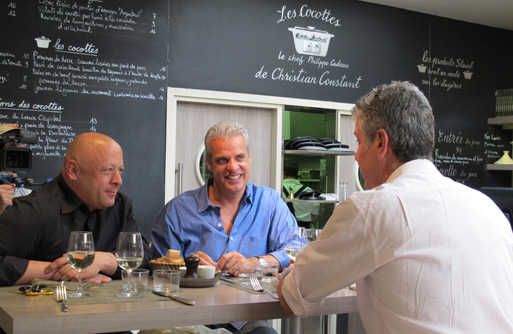
I adore cooking television. Food is one of the critical mediums of conveying culture. The plate someone serves you says so much more about them than just their abilities with a knife and a sauté pan. It conveys what they think is important; their point of view on life, and what they think is valuable. The epicenter of food culture? Paris. It’s a natural place for a food/travel hybrid show because the French have long understood that food is more than a means for sustenance.
What originally started as a show highlighting restaurants I could never afford in a city I may never visit, quickly turned into a profound statement on the shift in power from the establishment to the emerging generation (hang with me here, that statement sounded like something a seminary grad would say, give me a chance to explain myself.)
Neither Bourdain nor Ripert had been to Paris in a decade, even though Ripert is from France and trained under the most revered chef in the last 100 years. Quickly they discovered that the 3 star restaurants (1 Michelin Star is nearly impossible to get, 3 stars are reserved for the most elite) are losing their influence to a rising generation of brilliant young chefs. These chefs are passionate about food and exceedingly good and creative with its preparation, but are opening restaurants with a single prix fixe, daily changing menu aimed at reaching more customers. They are not concerned with the austerity, formality and exclusivity of the great restaurants. They would rather see average people introduced to exceptional food.
I couldn’t help but marvel at the scene unfolding in this show. Highly decorated and honored chefs were facing a challenge from a young generation with different priorities and stylistic approaches. The old were clashing with the new. It was a fascinating parallel to the change we are seeing in the church.
The Fundamentalist church in America was passionate about Christ (their product). Their ultimate purpose was His exaltation, and they would stop at no expense to see that realized. Because of their reverence for Him (much like the old chefs’ reverence for their food and technique) they demanded a level of commitment from people who wanted to engage in the experience. You needed to be dressed appropriately, attend the correct mega-service (or seating) and agree that the style of service (or presentation of the meal) was unsurpassed and not susceptible to change.
Now arrives the new generation. They too are passionate about Christ. Their ultimate purpose is His exaltation, and they will stop at no expense to see that realized. Because of their reverence for Him, they aim to make Him as accessible to the commoner as possible. You are invited to come dressed as you are, gathering together in more intimate and communal settings, and the experience is strangely familiar yet revolutionary. It is excellence deconstructed but not just for the sake of deconstruction. Rather, so that even more people can taste and see that it is good.
At the core, the two are the same, but the expressions of their passion couldn’t be further apart.
The culminating scene in the show has Bourdain and Ripert enjoying a meal at one of the highest rated new restaurants in Paris. After tasting one of the dishes, the multi-millionaire, cookbook-selling, master-chef exclaims that it is pure genius—the kind of dish that one only discovers once in a lifetime. Rather than feeling threatened, he grins and says there really is something to this new movement.
Cuisine is an expression of culture. Just like music it changes with time as thought adapts. It is philosophy extended to our dinner plates. Likewise, the way we interact with other believers in Church adapts over time. Those changes begin with the philosophers, but trickle down to the practitioners. Whether your church looks like the restaurant with 3 Michelin stars where every man must wear a coat and tie, or the gastro-pub where the chef wears his art as his sleeve, the way we practice our faith is in a state of adaptation.
Did you see the show? Where is your church on the scale? Which end do you think is “better?” Does style matter so long as Christ is central?
 Pastor Jeremy Stephens
Leave a comment